
Strategic maintenance optimization in aging gas turbine fleets: A Saudi Aramco case study
M. S. ALAHMADI and O. Y. ZIDAN,Saudi Aramco,Dhahran, Saudi Arabia
An often-overlooked aspect of the authors’ company’s operations is its extensive and diverse fleet of > 200 gas turbines with various capacities reaching up to 200 megawatts (MW). These units support a wide range of applications, including power generation, water injection, oil transfer and natural gas liquids (NGL) compression. Approximately 30% of the company’s turbine fleet is > 40 yrs old: the majority of the aged fleet is deployed in mechanical drive applications, while a handful of units are utilized for offshore power generation. Geographically, the units are distributed across Saudi Arabia with larger power generated units located near coastal areas, aero-derivatives units scattered from east to west, and other mechanical drives located in remote locations in the eastern province. FIG. 1 illustrates the authors’ company’s diverse gas turbine fleet in terms of application power, as per the International Organization for Standardization (ISO).
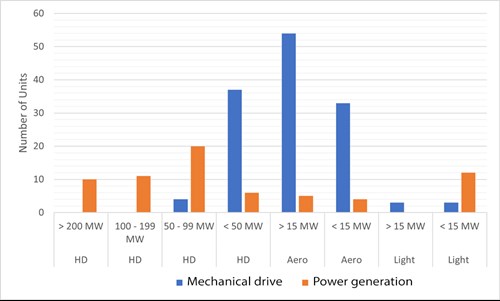
FIG. 1. The authors’ company’s gas turbine fleet profile, as per ISO standards.
The company’s diverse gas turbine fleet has provided it with various and comprehensive operational and maintenance experience, specifically due to the company’s transition from plant-specific maintenance to a centralized model. This supports the shift from an original equipment manufacturer (OEM)-recommended cycle to utilizing an extend-and-inspect approach over several operating facilities until the cost-to-benefit ratio of further extension becomes impractical.
Two approaches for extensions are discussed here. The first is the previously stated extend-and-inspect approach, and the other is the component upgrade through the OEM. The latter approach is beneficial when seeking a low-risk extension, as it can be supported by the OEM’s experience. However, the practicality of an extension through component upgrade should still undergo a technical evaluation, focusing on the following aspects:
- OEM experience and recommendations
- Operational benefits from the gas turbine extension
- Whether the upgrade captures all components that could limit the extension
- The component repair capability and expected repair cycle after the extension is applied
- The overall cost associated with the upgrade.
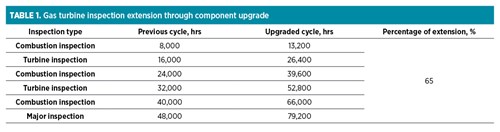
To illustrate, an upgrade offer for extension was provided to utilize advanced materials to increase a major overhaul by 50% of the original interval. This was ultimately not recommended due to limitations in repair and refurbishment capabilities, resulting in a decrease of component lifecycle. However, other upgrades have been evaluated—specifically those related to the hot gas path—and found beneficial, resulting in a decrease in required inspections over a specific time period and an increase in the inspection cycle for a single gas turbine (TABLE 1).
The implementation of the extend-and-inspect approach requires continuous technical evaluation throughout fleet operations. Insights gained on one unit can support the extension of sister/similar/complementary units and can eventually be applied across different models and applications. Key elements of these evaluations include:
- Operating parameters: Critical indicators of unit health include exhaust temperature, exhaust spread, compressor discharge, bearing temperature, equipment load, gas turbine programmable logic controller data with trip log and unit vibration. Inlet air filter differential pressure is essential in high-dust environments for high loading units.
- Operating mode: Gas turbines operating in cyclic or peak-load modes experience higher thermal and mechanical stresses compared to those in base-load operation. Frequent starts and trips also contribute to thermal fatigue. Units equipped with a dry low emissions/nitrogen oxides (NOx) combustion system are more sensitive to combustion-related degradation, especially when operated outside the specified envelope.
- Previous overhaul report: These reports form the basis for long-term extension strategies. Components found with minor wear and tear, small cracks in non-critical zones or typical degradation patterns will support in further extending the units without suffering additional cost during repair or forced outages. However, if components found at or beyond OEM-endorsed life limits (e.g., exhibiting significant cracks in high-stress areas, compressor blade root pitting or substantial coating loss) will require root cause analysis before any extension is considered (FIG. 2).
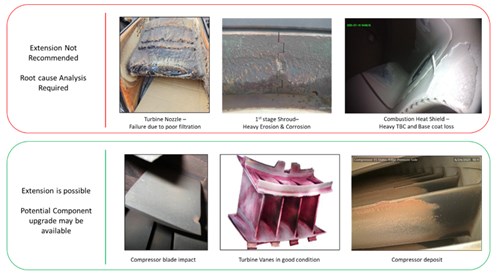
FIG. 2. Observations from previous overhauls.
In a Base Case demonstrating the effectiveness of the inspect-and-extend approach, a specific frame comprising more than 45 units had its maintenance inspection schedule extended by at least 20% with the potential improvement to reach up to 34%. This adjustment extended the lifecycle of critical components and reduced the frequency of combustion inspections by two per unit and achieved a cumulative reduction of 90 combustion inspections across the fleet over a period of 20 yrs. For larger frame gas turbines, which generally require more frequent inspections, the maintenance schedules were also altered, leading to an extension of 35% and 9% for combustion and major inspections, respectfully. Consequently, each unit experienced the elimination of two combustion and hot gas path (turbine) inspections, in terms of fleet-wide 22 combustion and turbine inspections.
Takeaway. Gas turbines are complex and highly engineered systems that require a structured maintenance schedule to achieve long-term benefits. The optimization of their maintenance regime can be effectively achieved either through the implementation of an extend-and-inspect approach or component life upgrades to potentially eliminate certain inspections altogether. These strategies should be carefully evaluated and selected based on the facility's risk tolerance, historical operational experience and the availability of vendor support for hardware upgrades and technical assurance. Any proposed extension must be underpinned by a comprehensive technical and risk assessment to ensure continued reliability, operational safety and compliance with industry best practices.
ABOUT THE AUTHORS
Muath S. Alahmadi is a gas turbine engineer with more than 8 yrs of experience at Saudi Aramco. He started his career as a plant engineer and assumed many roles in operations, maintenance and reliability engineering before moving on to a role in central engineering, specializing in the fleet management of gas turbines, project support and equipment standardization. Alahmadi is a member of the Saudi Aramco gas turbine standards committee. He earned his BS degree in mechanical engineering and an MS degree in engineering management from King Fahd University of Petroleum and Minerals.
Osama Y. Zidan is a gas turbine specialist at Saudi Aramco and has 20 yrs of work experience in leadership and technical operations in rotating equipment, specifically focusing on gas turbines, failure analysis, repair, technical consultation, standards development and project management. Zidan is the group leader for the company’s compressors and gas turbines group and serves as chairmen of the Saudi Aramco gas turbine standards committee. He earned an MSc degree in thermal power and fluid engineering from the University of Manchester in the UK.

Comments