
Antifoam performance in MDEA systems: Implications for cost-efficient solutions
A. AL-QAHTANIandM. R. TARIQ, Saudi Aramco, Dhahran, Saudi Arabia
Foaming remains a persistent operational challenge in amine-based gas treating units, particularly those utilizing methyldiethanolamine (MDEA) for acid gas removal. Foam formation—often triggered by surfactants, heavy hydrocarbons or degradation products—can lead to column flooding, reduced tray efficiency and compromised process performance. These issues can significantly affect the efficiency of gas sweetening units, potentially increasing downtime and operational costs.
To address this, antifoaming agents are commonly employed to destabilize foam films and prevent excessive foam buildup. However, traditional methods for selecting these agents rely heavily on empirical testing, which can be both time-consuming and inefficient. This article presents a novel, predictive approach to antifoam agent selection based on foaming tendency and stability parameters (FTSPs) derived from Hansen Solubility Parameters (HSPs). This method allows for a more scientific and systematic evaluation of compatibility between antifoaming agents and foam-stabilizing components in MDEA systems.
The analysis supports a potential technology transition from silicone-based to glycol-based antifoaming agents, aiming to enhance long-term system reliability, reduce heat exchanger fouling and filtration challenges, and improve solvent recovery in amine-based gas treating units (MDEA) at gas operation facilities. The experimental data from laboratory-scale foam tests and field deployment are analyzed in conjunction with FTSP values derived from the system components. The analysis of glycol-based antifoaming agents identified AF-4 as the most technically suitable candidate for deployment. AF-4 demonstrated superior foam suppression performance, reducing foam content from 28 milliliters (mL) to 8 mL (71%) within 19.58 sec, with a low chemical dosage of 0.072 grams (g). These results indicated high chemical efficiency, rapid action and operational effectiveness under laboratory conditions that mimic plant conditions. AGT-2, another glycol-based formulation, exhibited performance comparable to the current silicone-based standard (AGT-1), achieving foam reduction from 19 mL to 9 mL (53%) in 26.31 sec with a similar dosage rate. This performance makes AGT-2 a viable alternative.
MDEA systems. In industrial gas treating applications, foam formation is a common phenomenon that occurs at the liquid-gas interface. In MDEA systems, foam is typically stabilized by hydrocarbons, degradation byproducts or surfactants present in the feed gas or amine solution. These agents lower the surface tension and stabilize foam films, leading to operational challenges such as:
- Column flooding
- Reduced tray efficiency
- Poor mass transfer
- Increased amine losses.
To mitigate these issues, antifoaming agents are introduced into the system. However, the selection of the most effective agent is often based on trial-and-error approaches, which can be inefficient and costly.
This article introduces a predictive methodology for antifoam agent selection using HSP. By quantifying the affinity between antifoaming agents and foam-stabilizing components through the relative attraction (Ra) parameter, this approach enables a more rational and efficient formulation strategy.
The newly commissioned amine train at a gas plant, which utilizes MDEA as the primary solvent, also employs a silicone-based antifoaming formulation. This type of antifoam, while effective in foam suppression, has been observed to negatively impact downstream filtration systems. Specifically, silicone-based antifoams tend to saturate and prematurely deactivate activated carbon beds, significantly reducing their service life. Additionally, residual silicone compounds can damage guard filters, increasing maintenance frequency and overall operating costs.
Silicon-based antifoams can also cause fouling in amine systems, particularly in heat exchangers and amine column trays. Their hydrophobic nature and resistance to breakdown lead to accumulation on surfaces over time. In heat exchangers, silicon compounds may deposit and polymerize under heat, reducing thermal efficiency and increasing pressure drop especially in plate exchangers with narrow channels. In amine column trays, these antifoams can agglomerate, causing maldistribution, increased pressure drop and reduced tray efficiency. Regular tray inspection, alternative antifoam selection and side stream filtration help manage economic analysis estimates.
METHODOLOGY
Foam generation and antifoaming agents evaluation. The MDEA system was prepared and spiked with a known foam stabilizer (representative heavy hydrocarbon). Commercial silicone- and polyglycol-based antifoaming agents were tested for their defoaming performance (FIG. 1).
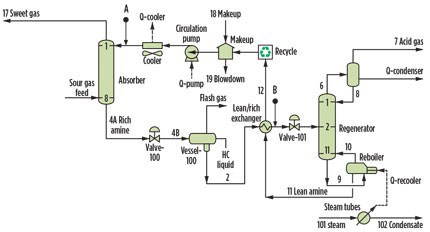
FIG. 1. Simplified amine gas sweetening process flow diagram. Points A and B represent the antifoaming injection points.
Laboratory testing. Foam tests were conducted using nitrogen sparging in a 20% MDEA solution with a foam stabilizer that was aerated for 30 sec after the addition of antifoaming agents [10 parts per million (ppm) dosage]. Foam height was recorded at multiple time intervals.
The comparative evaluation was conducted on four antifoaming agents under laboratory conditions. The objective was to assess performance characteristics such as foam suppression efficiency and compatibility with MDEA solvent systems. The agents’ assessments included AGT-1 (silicone-based), currently in use as the standard operational agent, and three glycol-based alternatives: AGT-2 (proposed alternative), AGT-3 and AAF-4 (both alternative candidates). TABLE 1 and FIG. 2 show the tested chemicals and their classification.
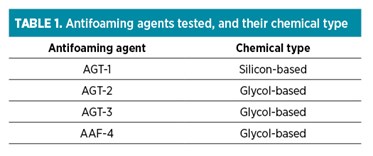
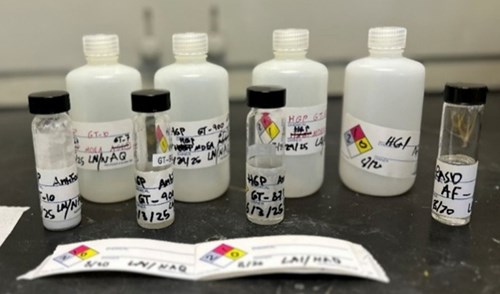
FIG. 2. Photograph of received antifoaming chemicals from the plant.
The testing was performed using a modified version of the ASTM-D892 method for foaming characteristics, as illustrated in FIG. 3. The procedure involved sample preparation by using 50 mL of amine solution into the lab testing column indicator, with a control sample prepared without an additive. Foam generation was initiated via sparging for a fixed duration of 2 min, after which foam volume and collapse behavior were recorded. Subsequent thermal conditioning was applied to selected samples, followed by surface tension analysis to evaluate performance retention under simulated field conditions.
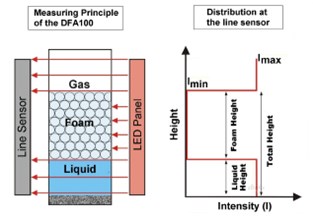
FIG. 3. Schematic diagram of defoamer testing experiential setup.
The analysis performance matrix included foaming tendency (%), defined as the volume of foam generated relative to the liquid baseline; foam stability index (in seconds), representing the time required for foam to collapse to 50% of its original height; and surface tension [milli-Newtons per meter (mN/m)], used as an indicator of interfacial activity and antifoam efficiency.
This standardized approach enabled a direct and meaningful comparison of the performance profiles of the selected antifoaming agents, supporting data-driven decision-making for potential deployment at the gas plant.
RESULTS AND DISCUSSION
Defoaming performance. The polyglycol agent reduced foam height by 85% within 30 sec, compared to 40%–60% for the silicon agent. The strong inverse correlation was observed between Ra values and foam height, with correlation coefficients of Ra = 0.91 at 30 sec and Ra = 0.88 at 210 sec, confirming the predictive power of the HSP-based approach.
The evaluation of four antifoaming agents assigned reference tags—AGT-1 (silicone-based), AGT-4, AGT-3 and AAF-4 (all glycol-based)—was conducted to assess their performance in foam suppression solvent, foam stability reduction and surface tension within an MDEA-based amine solution. AGT-1, the current operational practice, demonstrated consistent performance, reducing foaming tendency from 15 mL to 5 mL, with a foam stability index of 24 sec.
AGT-2, a glycol-based alternative, delivered performance comparable to AGT-1, achieving identical reductions in foaming tendency and foam stability index. The effectiveness of the HGP antifoam chemical against new antifoams is presented in TABLE 2 using a mixture of 50-mL MDEA solution and 3-mL antifoam chemical. One mL (equivalent to 3 drops) of each antifoam chemical was added to break the foam.
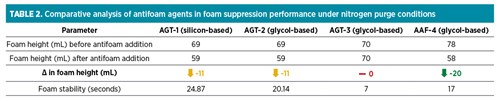
AGT-3 showed limited efficacy and did not reduce foam, while increasing the foam stability index to 26 sec. This indicates poor foam suppression and slower collapse dynamics, rendering it unsuitable for further consideration in this application.
AAF-4 emerged as the highest-performing agent, achieving a 71% reduction in foaming tendency, and the lowest foam stability index of 17 sec, demonstrating superior foam suppression kinetics and enhanced breakdown efficiency. These results position AAF-4 as a leading candidate for field validation and potential deployment (FIGS. 4–7).
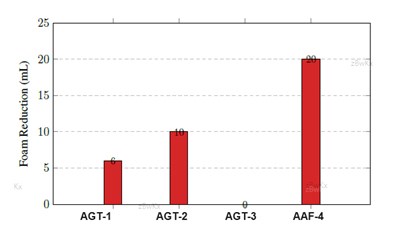
FIG. 4. Foam reduction performance showing AAF-4 achieving a 20-mL reduction, significantly outperforming other agents. AGT-3 demonstrated complete ineffectiveness with no foam reduction.
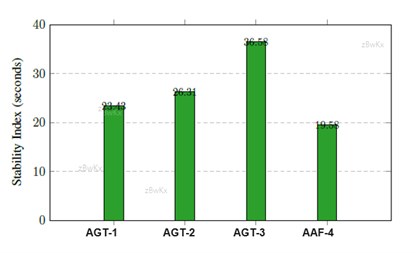
FIG. 5. Stability index characteristics showing AAF-4 with the fastest foam collapse at 19.58 sec, indicating superior rapid action. AGT-3 shows prolonged stability, suggesting poor antifoaming characteristics.
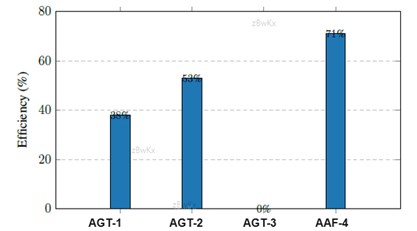
FIG. 6. Performance efficiency percentage calculated as (initial foam – final foam)/initial foam x 100%. AAF-4 demonstrated superior efficiency at 71%, while AGT-3 showed complete inefficiency.
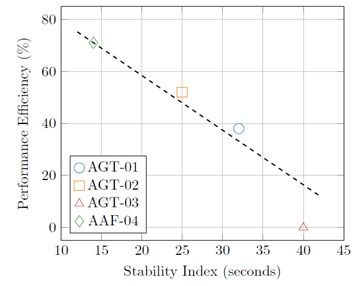
FIG. 7. Performance-stability diagram showing inverse correlation (AAF-4 achieved optimal balance with high performance and rapid action).
Glycol-based antifoaming agents exceeded the performance of traditional silicone-based agents in MDEA-based system. AGT-2 showed a drop-in compatible alternative to AGT-1, while AAF-4 presented a high-performance option for further operational assessment. TABLE 3 provides a summary of the antifoaming agents’ testing performance, and FIG. 8 displays the logarithmic dosage efficiency analysis.

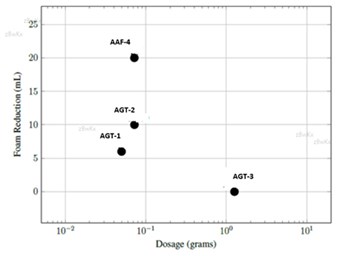
FIG. 8. Logarithmic dosage efficiency analysis. AAF-4 demonstrated superior foam reduction per unit dosage, while AGT-3 showed complete inefficiency.
Surface tension analysis. TABLE 4 shows surface tension values of anti-foamed MDEA measured in these experiments. The surface tension is another key indicator of foaming tendency, where lower surface tension correlates with higher foaming potential. The surface tension measurements were conducted on various antifoaming agent amine combinations to evaluate their impact on interfacial properties, which are indicative of antifoam efficiency and compatibility with the MDEA solvent system.

The analysis results are summarized below:
- The baseline sample fresh amine Fresh MDEA exhibited a mean surface tension of 40.5 mN/m.
- The amine mixed with antifoaming AGT-3 exhibited a mean surface tension of 36.3 mN/m.
- The AGT-2 sample showed a slightly reduced surface tension of 34.5 mN/m, showing moderate surface activity.
- Conspicuously, the AGT-1 solution, representing the current silicone-based antifoam standard, demonstrated the lowest surface tension at 28.5 mN/m, indicating lower surface activity and potentially stronger foam suppression characteristics.
- The AAF-4 sample, a glycol-based alternative, exhibited a surface tension of 35.2 mN/m, aligning closely with the AGT-3 formulation and indicating comparable surface behavior.
These findings suggest that while AGT-1 exhibits the strongest surface activity, glycol-based agents, such as AAF-4 and AGT-2, show moderate surface tension modification with potentially improved compatibility in MDEA-based systems. This statement shows that AGT-1 has better surface activity; however, AAF-4 has better foaming reduction efficiency. FIG. 9 shows the surface activity correlation analysis.
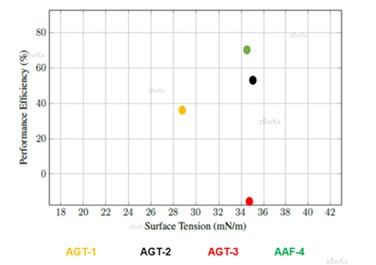
FIG. 9. Surface activity correlation analysis. AAF-4 (green) showed maximum foam reduction despite moderate surface tension, indicating superior film rupture mechanism.
Takeaway. This study successfully applied HSP to evaluate and predict the performance of antifoaming agents in MDEA-based gas treating systems. The Ra parameter proved to be a reliable indicator of antifoam-agent compatibility and defoaming efficiency.
The polyglycol antifoaming agent demonstrated superior performance in both laboratory and field trials, validating the effectiveness of the HSP-based method.
This predictive methodology can significantly reduce the time and cost associated with antifoaming agent selection, while enhancing operational reliability and process efficiency in gas treating units. Future studies will explore the application of this approach in other amine systems and under varying operational conditions, such as temperature and pressure.
The comparative evaluation of glycol-based antifoaming agents within the MDEA-based amine system at HGP has yielded actionable insights into foam distraction. Among the tested agents, AAF-4 emerged as the most technically viable option, presenting superior foam suppression, rapid foam breakdown and efficient dosing characteristics. In addition, AGT-2 presented a viable alternative with performance metrics closely aligned with AAF-4 and AGT-1, while AGT-3 has been considered unsuitable due to its suboptimal performance. AGT-1, the current field standard, remains effective but may be phased out in favor of AAF-4 or AGT-2 should field trials show enhanced operational efficiency and process control.
ACKNOLEDGEMENTS
The authors would like to express their gratitude to the HGP engineering team for their technical support and provision of field data. Special appreciation is extended to the technical personnel involved in laboratory testing and data analysis.
ABOUT THE AUTHORS
Nasser A. Al-Qahtani serves as a Lead Engineer in Aramco’s Technology Oversight and Coordination division within the Research and Analytical Services Department. He has been instrumental in the design, commissioning and operational support of gas sweetening and hydrocarbon oil stabilization plants. Al-Qahtani led the design and pre-commissioning efforts for the Tanajib Gas Plant’s flaring and utility systems, and has made significant contributions to various process optimization, energy efficiency and environmental sustainability projects. He is the author of numerous technical and management publications and has been awarded five U.S. patents for his innovative work in the oil and gas sector.
Muhammad Rizwan Tariq is an Engineering Specialist in the Process Consulting Services Department of Saudi Aramco. Previously, he served as Staff/Senior Engineer at JGC Japan, Worley Oman, PDO Oman and OGDCL Pakistan. He has been instrumental in the design, commissioning and operational support of gas sweetening, gas dehydration, liquefied petroleum gas (LPG) production and treatment, sour water treatment and hydrocarbon condensate stabilization plants. Tariq earned a BS degree in chemical engineering from Punjab University in Lahore, Pakistan. He is also a Chartered Member of IChemE UK, and a professional member with the Saudi Council of Engineers and PEC Pakistan.

Comments