

LNG-fueled vessels and the new era of the gas value chain
The global gas market is experiencing considerable change. Demand growth in Asia, renewed investment in liquefaction facilities and the restructuring of major trade routes have all influenced how gas is produced, transported and processed. At the same time, emissions regulations are becoming more stringent, placing additional expectations on marine and gas-handling assets.
Within this shifting landscape, LNG as a marine fuel is gaining prominence. It provides immediate emissions reductions and offers a practical route towards bio-LNG and synthetic methane (CH4) in the future. For companies involved in LNG shipping, bunkering, processing and floating infrastructure, the question is no longer whether LNG fuel will be important. Instead, the focus is on how vessel technologies can support wider value chain performance.
Evolving dynamics. The past few years have redefined global LNG movements. Europe’s emphasis on energy security, increasing Asian import demand and new liquefaction projects in the U.S. and the Middle East have contributed to a more diversified global market. These developments have strengthened LNG’s position as a transitional fuel, not only for power generation but increasingly for industrial use, transport and flexible grid balancing.
There is also a clear geographical shift in LNG consumption. Countries in South and Southeast Asia are increasing imports as they replace oil and coal with gas in both the power and industrial sectors. This trend is encouraging more investment in floating storage units and small-scale regasification systems, which in turn rely on efficient LNG-fueled support vessels to keep supply chains moving.
At the same time, maritime regulation continues to tighten. The International Maritime Organization’s (IMO’s) Carbon Intensity Indicator (CII) and Energy Efficiency Existing Ship Index (EEXI), together with the European Union’s (EU’s) inclusion of maritime operations in the Emissions Trading System (ETS) and FuelEU Maritime, have introduced greater compliance pressures. These requirements are reshaping technology choices and encouraging operators to adopt lower-emissions solutions.
Although LNG carriers remain central to global LNG transport, LNG-fueled systems are now supporting a far broader range of vessel types. Dual-fuel engines, hybrid power systems, advanced gas-handling equipment and integrated control platforms are increasingly deployed on bunker vessels, floating storage units, offshore support vessels, shuttle tankers, small-scale LNG distribution craft, floating LNG (FLNG) support units, harbor tugs and terminal service vessels.
Each of these vessel types has a direct influence on how efficiently LNG moves through the supply chain. Their performance affects fuel availability, the speed and reliability of bunkering operations, the management of boil-off gas and the overall environmental footprint of LNG logistics. As small-scale LNG networks and decentralized regasification continue to expand, vessel capability becomes even more important to ensure affordable and stable gas supply.
LNG for compliance and cost advantage. The author’s company’s recent Future Fuels Report indicated that forthcoming policy measures (e.g., the EU ETS and Fuel Maritime penalty) are likely to make conventional fossil diesel fuel significantly more expensive by the end of this decade; beyond 2030, the emissions trading fees will be higher than the fuel costs. The company’s projections suggest that the combined effect of carbon pricing and efficiency requirements could lead to fossil diesel fuel costs rising to roughly twice their current level by 2030 (FIG. 1). As the cost of using traditional fuels increases, the price gap between them and low-carbon alternatives, including renewable fuels, is expected to narrow rapidly.
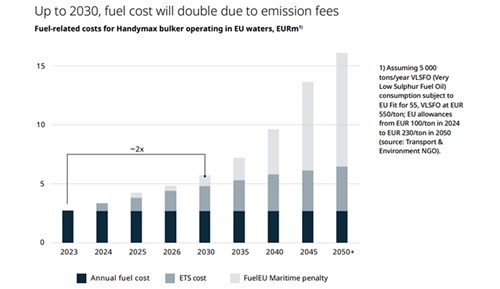
FIG. 1. The author’s company’s Future Fuels Report predicts EU ETS and FuelEU Maritime policies will double costs for fossil diesel fuel costs by 2030.
Carbon pricing in Europe continues to rise, and it is increasingly affecting vessel operating costs. Allowances under the EU ETS averaged about €78/t of carbon dioxide (CO2) in 2024, and the author’s company forecast prices to increase to > €100 by 2030. By 2035, sustainable fuels will reach cost parity with fossil fuels. As these costs increase, emissions reduction becomes a financial priority as well as an environmental one. A lower greenhouse gas footprint reduces charges under FuelEU Maritime and supports a stronger CII rating, both of which influence operating margins and charter decisions.
Within this policy landscape, LNG stands out as a practical option for owners seeking to limit exposure to rising carbon costs. Fossil LNG delivers approximately the same emissions trading fees as the use of fossil diesel fuel with a CH4 slip rate of 3.1%, but lower CH4 slip rates provide significantly lower emissions trading fees. The author’s company’s innovative combustion technologya achieves CH4 slip as low as 1.1% in a wide range. This offers significant savings in emissions trading fees. For example, the use of fossil LNG with a CH4 slip of 1.1% means ETS costs will be approximately 20% lower. It will also be overcompliant for FuelEU Maritime fees until 2034. Overcompliance can compensate the ETS costs, so depending on how the overcompliance is used, it is possible to achieve savings on emissions trading fees of approximately 80% until 2034. The savings potential with LNG is enormous, but it also must be pointed out that these savings are only possible with lower CH4 slip rates.
What this shows is that once emissions charges are considered, LNG approaches cost competitiveness with traditional fuels much earlier than previously expected, providing a strong economic incentive for operators—especially those operating in regions with new emissions regulations—to incorporate LNG into their compliance and long-term fuel strategies. However, these financial benefits are not just about avoiding penalties. Utilizing LNG enhances operating margins and boosts competitiveness in charter tenders. Furthermore, LNG produces less CO2 than oil-based fuels and substantially reduces sulfur oxides, nitrogen oxides and particulate matter, enabling operators to satisfy IMO and EU requirements without the need for uncertain alternatives or significant changes to existing infrastructure.
Financial institutions are also embedding emissions performance in their lending frameworks. Banks aligned with the Poseidon Principles assess loan portfolios against IMO decarbonization trajectories, making fuel choice increasingly relevant to credit decisions. LNG benefits from established lifecycle data and recognized certification schemes, providing transparency for lenders and supporting access to finance for vessels trading in regulated regions.
Engine efficiency, hybrid and digitalization. Modern dual-fuel engines have developed to the point where they are no longer simply an entry route into LNG, but a platform that allows operators to keep improving performance over the vessel’s lifetime. They offer the flexibility to use LNG today and transition to renewable CH4 variants as they become available, without the need for major changes to fuel storage or supply systems. This gives owners a practical way to reduce emissions now while maintaining a clear pathway to decarbonization later.
The focus has also shifted from debating CH4 slip to reducing it in practice. Advances in combustion control, fuel-air mixing and ignition timing now achieve far lower slip across the full operating range. For vessels already in service, software and combustion upgrades can deliver meaningful reductions without significant hardware modifications. Greater automation also means more consistent performance between voyages, which is increasingly important for operators reporting verified emissions data.
The wider trend is one of optimization. CH4 slip is falling, combustion efficiency is improving and the engines themselves are becoming more adaptable. As renewable LNG options mature, dual-fuel propulsion provides a bridge between current regulatory requirements and future fuel solutions, strengthening both compliance and long-term operational flexibility.
Alongside engine development, integration and hybridization are becoming central to achieving higher efficiency. An example of this in practise would be the author’s company’s propulsion systemb concept (FIG. 2). It brings dual-fuel engines, energy storage and electrical controls together under a single operating framework. This creates smoother load transitions, improves overall efficiency and reduces fuel consumption. During manoeuvring, thruster operation or time spent in port, the system can automatically choose the most suitable power source, always ensuring the most consistent and economical performance possible.
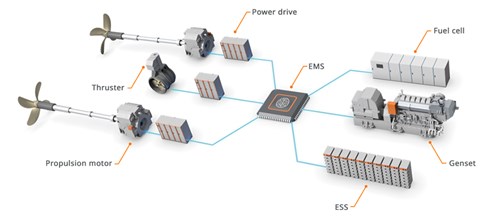
FIG. 2. The author’s company’s propulsion systemb concept combines dual-fuel engines, batteries and power electronics under unified control.
Digital tools also support these gains over the vessel’s lifetime. Real-time monitoring and predictive analytics allow crews to identify deviations early, optimize engine settings and plan maintenance more accurately.
The impact. The long service life of vessels means that any fuel strategy must account for future availability as well as present needs. LNG is well positioned in this respect. Engines designed for LNG are increasingly compatible with renewable CH4-based fuels. Bio-LNG and synthetic CH4 can be used within existing storage and handling systems with minimal modification, providing a credible route to further emissions reductions without committing to completely new fueling arrangements.
This flexibility is becoming more important as decarbonization measures tighten. Operators investing in LNG-ready systems today reduce the risk of costly conversions later. Vessels offering a clear emissions pathway are also more attractive to charterers and financiers seeking alignment with long-term sustainability goals.
LNG-fueled vessels also support the stability and efficiency of modern gas networks. Their behavior affects offshore liquefaction units, floating storage and regasification facilities, and regional distribution terminals. In emerging markets, they are essential for establishing reliable small-scale LNG corridors that extend gas access to remote areas.
LNG will almost certainly not be the final solution for maritime decarbonization, but at present, it is the option that works most effectively for a large part of the global tanker fleet. It remains technically proven, commercially viable and aligned with current regulations. For operators facing rising carbon costs within the next 18 mos, this is not an abstract advantage. It can be the difference between being prepared for the transition and struggling to respond to it.
By 2030, the European carbon market alone could add more than €2 MM/yr to the operating costs of a 50,000-deadweight tonnage (DWT) tanker running on heavy fuel oil. Few shipowners can afford to ignore that scale of financial pressure, which is why LNG is becoming a practical starting point for compliance.
The path to net-zero will involve several fuel and technology choices, but vessels adopting LNG today will not be starting again from scratch. Efficient dual-fuel propulsion, lower CH4 slip across the operating range, integrated power systems and digital lifecycle optimization already demonstrate that improved environmental performance can be achieved without undermining commercial viability.
NOTES
a Wärtsiläs NextDF technology
b Wärtsilä HY


Comments