

U.S. natural gas exports to grow nearly 30% by 2027 as LNG facilities ramp up
The U.S. EIA’s latest Short-Term Energy Outlook (STEO) forecasted that U.S. liquefied natural gas (LNG) exports will continue to increase as five LNG export projects start operations and ramp up production by the end of 2027. The EIA also forecast increased natural gas pipeline exports, mainly to Mexico. In our forecast, net exports of U.S. natural gas (exports minus imports) grow 18% to 18.7 billion cubic feet per day (Bcf/d) in 2026. In 2027, net exports increase another 10% to 20.5 Bcf/d.
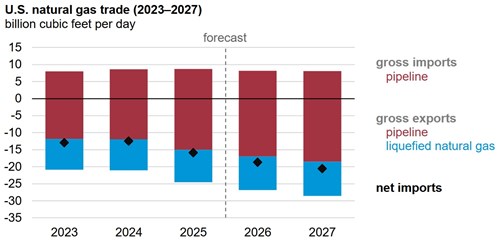
The EIA forecast that U.S. LNG exports rise 1.9 Bcf/d in 2026 to average 17.0 Bcf/d and increase by an additional 9% (1.5 Bcf/d) in 2027. We forecast natural gas pipeline exports to grow by 4% (0.4 Bcf/d) in 2026 and 2% (0.2 Bcf/d) in 2027.
U.S. LNG export terminals are expected to run at slightly higher utilization rates in 2026 despite already running at relatively high rates in 2025 because recent disruptions to LNG exports through the Strait of Hormuz are increasing demand for LNG cargoes from outside the strait. The disruptions, mostly concentrated in Qatar, currently represent over 10 Bcf/d, or 20% of global supply. Qatar also sustained damage to 17% of its export capacity after a March 18 attack on the Ras Laffan LNG export facility damaged two liquefaction trains. QatarEnergy estimates repairs on the damaged trains could take up to five years.
Current U.S. peak export capacity is 18.3 Bcf/d. In 2026, Corpus Christi Stage 3 will start up trains 5–7 (0.6 Bcf/d combined), and Golden Pass LNG will start up its first two trains (1.4 Bcf/d). We expect Port Arthur LNG Phase 1 (1.6 Bcf/d), Rio Grande LNG Trains 1 & 2 (1.4 Bcf/d), and the final train of Golden Pass LNG (0.7 Bcf/d) will begin exports next year. In addition to these new terminals, Plaquemines LNG and Elba Island LNG received DOE approval in March and April 2026 to increase their permitted exports by 0.5 Bcf/d and 0.1 Bcf/d, respectively.
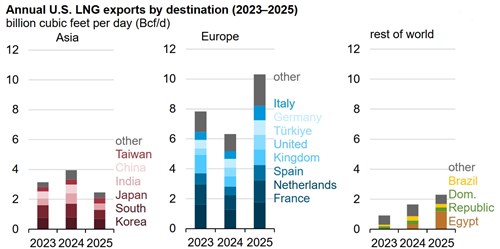
In 2025, U.S. LNG exports to Europe reached a record 10.3 Bcf/d, up from 6.3 Bcf/d in 2024 and accounted for 68% of LNG export volumes, according to the EIA’s Natural Gas Monthly. Exports to Italy (+0.5 Bcf/d) and Poland (+0.3 Bcf/d) rose the fastest in Europe. Exports to Asia fell from 4.0 Bcf/d in 2024 to 2.5 Bcf/d in 2025, representing 16% of LNG export volumes. China-bound U.S. LNG exports fell to zero in 2025 from 0.6 Bcf/d in 2024 as traders resold cargoes due to trade tensions. Additionally, exports to Egypt quadrupled from 0.3 Bcf/d in 2024 to 1.2 Bcf/d in 2025, which drove a 0.7 Bcf/d increase in exports to the rest of the world.
U.S. LNG imports, which primarily serve New England and generally peak in winter months, were essentially unchanged at less than 0.1 Bcf/d in 2025. The EIA expect LNG imports to average 0.1 Bcf/d in 2026–27 and continue to serve as a marginal supply source during periods of high demand, particularly in the winter months.
The EIA expect U.S. pipeline exports to continue increasing over the forecast period, reaching 9.8 Bcf/d in 2026 and 10.0 Bcf/d in 2027, after rising 0.4 Bcf/d in 2025 to average 9.5 Bcf/d. This upward trend is driven by Mexico’s growing demand for natural gas, both from growth in power generation and the development of two new LNG export facilities expected to come online over the next two years. Those facilities will be fed by U.S.-origin pipeline gas exports. The Energía Costa Azul LNG terminal and the second phase of Fast LNG Altamira Floating LNG production vessel (called FLNG2) will have a combined 0.6 Bcf/d of export capacity and are expected to come online in 2026 and 2027, respectively.
U.S. natural gas pipeline imports from Canada rose by 0.1 Bcf/d in 2025, averaging 8.6 Bcf/d. We expect pipeline imports from Canada to decrease to 8.0 Bcf/d in 2027 as two LNG facilities with a combined capacity of 2.1 Bcf/d along the west coast of Canada ramp up over the next few years, and Northeast U.S. natural gas demand is supplied by production growth in the Appalachia region.
Related News
Related News

- Cheniere signs deal with Bechtel to expand U.S. LNG export capacity
- TC Energy approves $1.5-B Columbia Gas expansion after profit tops estimates
- Wärtsilä continues to expand its data center footprint with new 790 MW order in Texas
- Baker Hughes’ fuel flexible NovaLT™ 16 gas turbine certified by RINA for marine propulsion
- Japan got bulk of Russian LNG from Sakhalin-2 in 2025

Comments