

Safely and accurately measure hydrogen blends using emissions-free sampling
G. DUDGEON, Endress+Hauser, Houston, Texas (U.S.); and K. GARRISON, Endress+Hauser, Philadelphia, Pennsylvania (U.S.)
As industry continues to explore viable sustainable fuels, hydrogen (H2) has emerged as a front-runner in the alternative energy landscape. H2 blending is a key supporting initiative, which entails injecting H2 into existing natural gas pipeline networks to reduce carbon emissions.
This approach leverages trillions of dollars of existing infrastructure, accelerating clean fuel adoption without extensive capital costs. However, it also introduces a critical challenge: accurately, safely and continuously monitoring the precise composition of the blended gas. The variable nature of the blend may require real-time analysis to ensure process safety and protect downstream equipment, such as combustion turbines and household appliances. Without continuous measurement, even small changes in feed composition or flow can drive H2 concentrations outside safe operating limits.
Natural gas composition varies, but typically not enough to warrant constant testing. Conversely, blending H2 into natural gas may require real-time analysis to ensure process safety and protect equipment. However, traditional analytical methods usually vent a gas sample to the atmosphere after analysis, presenting an opportunity to reduce emissions. This article explains the mechanics and benefits of zero-emissions gas sampling systems, which can provide reliable sample composition data while returning the sample back into the process stream following analysis.
Conventional gas sampling pitfalls. Traditional gas sampling methods can sometimes pose environmental and safety concerns, depending on the process media. To understand the innovation of closed-loop systems, the limitations of existing widespread methods must first be understood.
Conventionally, a sample is extracted from a pipeline via a probe and transported through lengthy tubing to a remote analyzer house or shed, often located hundreds of feet away, where a gas chromatograph (GC) analyzes the extracted specimen. Once the analysis is complete, the carrier and sample gas are typically vented directly to the atmosphere or sent to a flare stack.
This method of disposal produces environmental emissions and waste. Direct venting releases both methane (CH4), a potent greenhouse gas (GHG), and the valuable H2 product. As regulations ebb and flow in industry, the routine venting of process gas can become a liability.
Additionally, it presents safety hazards. H2 is a small, elusive, highly-flammable molecule. The release of flammable, H2-rich gas mixtures poses an explosion risk.
Furthermore, the physical distance a sample must travel using these methods creates a process lag, meaning that by the time the gas traverses the piping route and the GC completes its measurement, the sample data is no longer current. This delay makes real-time process control—critical for maintaining a steady H2 blend ratio—nearly impossible.
In addition, as the gas travels through transfer lines, it is subjected to changes in ambient temperature and pressure. These fluctuations can cause dewpoint dropout, where heavier hydrocarbons condense out of the gas phase into liquid. When this occurs, the sample at the analyzer no longer reflects the true composition of the gas in the pipeline, causing skewed data and potential downstream control inefficiencies.
Closed-loop, zero-emissions systems drive sustainability. Zero-emissions sample systems address these and other issues by eliminating venting and providing real-time data. Their design is centered on a closed-loop principle where the analyzed gas is safely returned to the process, rather than expelled to atmosphere.
This closed-loop circulation is achieved using a precisely engineered scoop probe. Unlike traditional straight quills, this probe is designed to harness the physics of the process media flow itself to drive sampling, eliminating the need for external pumps, which can fail.
The probe inserts into the main process pipe, featuring a scoop-like opening at the tip that faces the direction of the flow (FIG. 1).
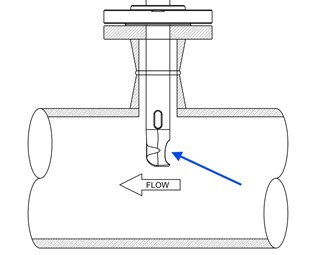
FIG. 1. A scoop probe installed in the main process pipe downstream of the blending point.
When the moving process fluid encounters this scoop, it is forced to slow down. According to Bernoulli’s Principle in fluid dynamics, as the velocity of the fluid decreases at the stagnation point of the scoop, its kinetic energy is converted into potential energy, resulting in a localized increase in pressure and ensuring laminar flow sampling, even at low velocities (FIG. 2).
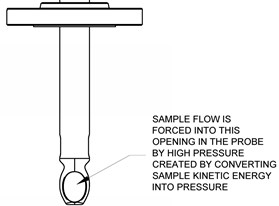
FIG. 2. The sample flow is forced into the probe opening, where kinetic energy is converted into potential energy in the form of high pressure.
The process fluid flowing around the outside of the probe accelerates, which reduces the pressure at the return ports located on the sides or back of the probe (FIG. 3).
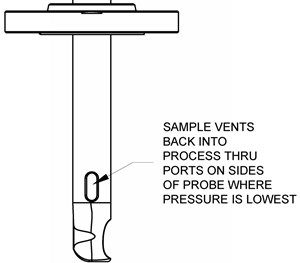
FIG. 3. After the sample is analyzed, it is vented back into the process stream through low-pressure ports on the side or back of the probe.
This creates a differential pressure between the high-pressure scoop inlet and the low-pressure return vents to drive a continuous and high-speed sample flow out of the scoop, through a short external fast loop (FIG. 4) and back into the process pipe via the return ports.
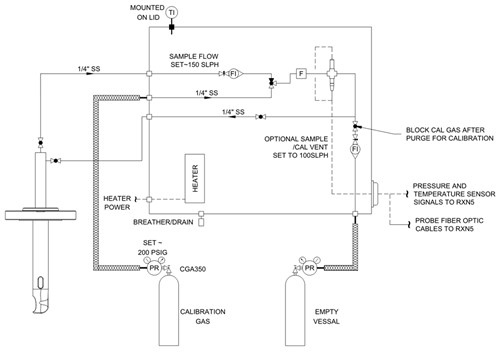
FIG. 4. The process flow diagram shows a closed-loop, zero-emissions sample system delivering a continuous, pressure-controlled gas sample to a Raman analyzer probe, with all purge and calibration gases safely captured or returned to the process. This eliminates atmospheric venting while ensuring accurate measurement.
The system is elegant in its simplicity, possessing no moving parts and requiring no electricity to move the sample, and the loop’s low internal volume creates fast exchange rates and response times.
An advanced analyzer is installed directly in this loop to measure the gas composition in-situ and in near real time. For H2 blending applications, Raman spectroscopy is typically the measurement technology of choice due to the gas’ strong Raman scattering response.
Unlike gas chromatography, which requires carrier gases and column separation, Raman spectroscopy uses a laser to analyze the vibrational fingerprint of the sample. The laser travels via fiber optic cables to the probe mounted in the loop, measuring multiple components simultaneously—including H2, CH4, carbon dioxide (CO2) and others—in seconds.
Because the analyzer probe is located at the tap point within the fast loop, the sample is constantly refreshed and representative of near real-time conditions. There are no long transport lines to cause lag or dewpoint dropout.
Furthermore, by returning the sample gas to the process, the system:
- Enhances safety: Keeps flammable gases contained within the piping.
- Ensures compliance: Meets standards from the GHG Protocol, the U.S. Environmental Protection Agency (EPA) and the Pipeline and Hazardous Materials Safety Administration (PHMSA) regarding GHG release.
- Prevents product loss: Valuable fuel is not vented as waste.
- Enhances control: Provides the near instantaneous feedback required to regulate control valves and maintain precise blending ratios.
Results: Increasing H2 blending precision. A mid-sized natural gas power plant sought to reduce its carbon footprint by blending H2 into the feed fuel stream at a target concentration of 5%. The operation was not without risk, however. A spike above 6% could exceed the thermal rating of the gas turbines, while a drop would reduce the decarbonization benefits of H2 blending.
To meet this precise blend ratio and ensure safety, the utility implemented an automated, programmable logic controller (PLC)-controlled blending skid equipped with a zero-emissions gas sampling system. The skid was fitted with a scoop probe installed downstream of the mixing point, whereby it drew samples directly to the authors’ company’s probea in the fast loop, connected via fiber optic cables to a nearby Raman analyzerb (FIG. 5).
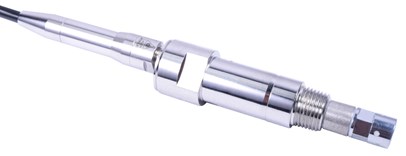
FIG. 5. A power provider used the authors’ company’s probea to measure the composition of H2-injected natural gas feeding its turbines. The probe was connected to a nearby Raman analyzerb using fiber optic cables to verify the blend and provide near real-time feedback to the PLC-based control system for prompt adjustments, as needed.
The sample stream is driven by the process flow’s kinetic energy, providing continuous and simultaneous measurement of H2, CH4, ethane and inert gases. Because the system is closed-loop, the plant avoided the logistical and safety headaches of managing exhaust vents in hazardous areas. This approach reduced blend variability and eliminated analyzer-related emissions at the site.
Additionally, this setup reduced the data latency from minutes, typical of a GC, to seconds. The near real-time data provided blend ratio feedback to the PLC with high precision, and when the analyzer detected a shift in the natural gas feedstock composition that altered the blend percentage, the PLC immediately adjusted the H2 injection line control valves to compensate.
This closed-loop system ensured that no flammable gas ever escaped, satisfying the plant’s stringent safety protocols and National Fire Protection Association (NFPA) fire codes. These efforts successfully reduced emissions and provided the power company with precise data for regulatory reporting, while protecting its assets and personnel from the risks of H2 leaks.
Supporting the H2 transition. H2 blending is a practical and scalable pathway toward a cleaner energy future. However, its success hinges on the ability to analyze new gas compositions safely and accurately. Conventional methods that employ waste venting are incompatible with a net-zero future.
Zero-emissions sampling systems directly address the shortcomings of these older methods, eliminating emissions, reducing waste, enhancing safety and providing the real-time control building blocks that are essential for precise processes. This technology is a key enabler for the budding H2 economy, empowering operators to manage the variables of blending with confidence, simultaneously ensuring both safety and effectiveness when experimenting with alternative energy sources.
NOTES
a Endress+Hauser’s Raman Rxn-30 probe
b Endress+Hauser’s Raman Rxn5 process analyzer
ABOUT THE AUTHORS
Alec G. Dudgeon is an Analyzer Engineer III at Endress+Hauser, where he specializes in analyzer sampling systems and application-specific system design. He earned a BS degree in electrical engineering from Northern Illinois University and collaborates across engineering, sales and manufacturing teams to deliver compliant, field-ready solutions for complex gas analysis challenges. His professional interests include H2 applications, emissions-free sample extraction and improving analyzer performance in demanding industrial environments.
Kate Garrison is a National Optical Analysis Product Marketing Manager at Endress+Hauser, focusing on the life sciences and chemical industries. She graduated from Rose-Hulman Institute of Technology in 2021 with a BS degree in biomedical engineering and has a background using Raman spectroscopy for purity synthesis and early-stage research. Garrison spent her first four years at Endress+Hauser as a sales engineer, focusing on the optical analysis product line and developing knowledge about products and services. She is currently focused on enhancing the strategic vision, leadership and marketing for Endress+Hauser optical analysis products.


Comments