

Restrain the stealth risks in the hydrocarbon processing industry
A. J. KHAN, Safety Consultant, Riyadh, Saudi Arabia
The oil and gas industry has always struggled to learn from its safety incidents, both internally and globally. While global incident data sharing initiatives have played an incredibly important role in sharing information and supporting the industry in proactive incident prevention, some issues still trickle down between the cracks.
This article discusses the latent threats and vulnerabilities that often escape scrutiny until it is too late, and examines five often overlooked risks:
- Small bore piping (SBP) failures
- Acoustic/flow-induced vibrations
- Static electricity ignition
- Aging infrastructure
- Cybersecurity in process control.
Real-life incidents, global standards that can aid prevention and actions operators can take to ensure sustainable resistance to these risks are also explored.
Risk 1: SBP failures. Two separate failures at a natural gas facility in Australia resulted in Tier 2 hydrocarbon releases. Both incidents involved cracking in small-bore piping connected to relief paths from compressors, shown in FIG 1.
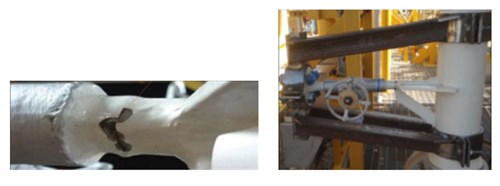
FIG. 1. Two incidents of cracking in small-bore piping at a natural gas facility in Australia.1
Vibration-induced fatigue was identified as the root cause, exacerbated by inadequate bracing and high operational rates.1
Applicable standards include:
- American Petroleum Institute (API) 618 specifies acoustic-mechanical design validation for reciprocating compressors to prevent pulsation-induced fatigue.
- Energy Institute (EI) guidelines recommend vibration screening for small-bore attachments and maintaining natural frequency above critical thresholds.
- API RP 688 provides vibration control practices for positive displacement machinery systems.
Recommendations include:
- Conduct vibration analysis during design and after major modifications (API 618, API RP 688).
- Install gussets and clamps to increase stiffness and natural frequency (EI guidelines).
- Include SBP in risk-based inspection programs [Center for Chemical Process Safety (CCPS) mechanical integrity].
Risk 2: Acoustic-induced vibration (AIV) and flow-induced vibration (FIV). A relief valve outlet ruptured during emergency depressurization at a gas plant, causing a major release within seconds. The ensuing investigation revealed high-frequency acoustic energy from a pressure drop triggered by shell-mode vibration, leading to fatigue failure (FIG. 2).2
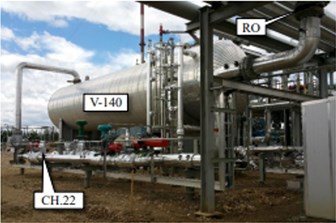
FIG. 2. Piping downstream of the restrictive orifice plate.
Applicable standards include:
- API RP 688 defines screening and detailed assessment methods for acoustic-induced vibration AIV/FIV, including sound power level calculations and diameter/thickness ratio checks.
- EI guidelines recommend maintaining pipe schedules and avoiding thin-wall designs in high-energy systems.
Recommendations include:
- Perform AIV/FIV screening for systems with pressure-reducing devices (API RP 688).
- Use thicker pipe schedules and low-noise trim valves (EI guidelines).
- Apply gusseting and bracing for small-bore branches near relief valves.
Risk 3: Static electricity ignition. In 2007, a fire and explosions occurred at Barton Solvents during the filling of a portable tank with ethyl acetate (FIG. 3).
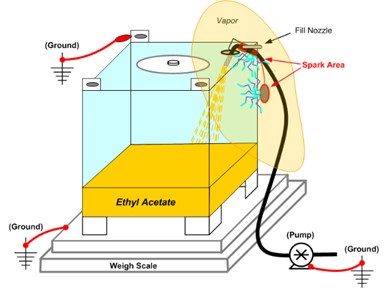
FIG. 3. During the filling of a portable tank with ethyl acetate, a static spark ignited vapors near the fill opening.3
A static spark ignited vapors near the fill opening, destroying the warehouse and causing injuries.3
Applicable standards include:
- U.S. National Fire Protection Association (NFPA) 77 covers bonding, grounding and conductivity checks for flammable liquid handling.
- NFPA 30 defines flammable liquid classifications and storage requirements.
Recommendations include:
- Bond and ground all transfer equipment per NFPA 77.
- Use dip pipes for top-filling operations and maintain conductivity checks.
- Train personnel on electrostatic hazards and emergency response.
Risk 4: Aging infrastructure. A 30-in. crude oil pipeline ruptured due to atmospheric corrosion, releasing 208 m³ of oil (FIG. 4).
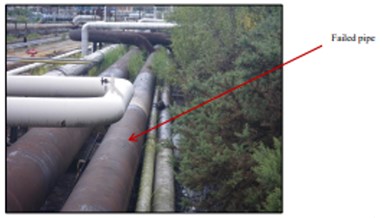
FIG. 4. Location of incident and non-incident pipeline sections.
The pipeline had exceeded its design life, and inspection regimes failed to detect extensive wall thinning.4
Applicable standards include:
- API 579-1/American Society of Mechanical Engineers (ASME) FFS-1 provides fitness-for-service (FFS) assessment for aging equipment, including Levels 1–3 evaluations for corrosion, cracking and fatigue.
- CCPS risk-based process safety (RBPS) emphasizes lifecycle integrity management and proactive replacement strategies.
Recommendations include:
- Implement periodic FFS assessments per API 579.
- Integrate risk-based inspection (RBI) programs with corrosion monitoring and predictive analytics.
- Prioritize replacement of high-risk assets nearing end-of-life.
Risk 5: Cybersecurity in process control. The Colonial Pipeline ransomware attack in 2021 disrupted fuel supply across the U.S. East Coast, highlighting vulnerabilities in operational technology (OT) systems integrated with information technology (IT) networks.5
Applicable standards include:
- CCPS guidelines recommend integrating cybersecurity into an RBPS framework.
- International Society of Automation (ISA)/IEC 62443 provides security requirements for industrial automation and control systems.
Recommendations include:
- Segment OT and IT networks and enforce multi-factor authentication (ISA/IEC 62443).
- Develop cybersecurity policies and threat response plans (CCPS cybersecurity guidelines).
- Conduct regular vulnerability assessments and employee training.
Takeaways. Hidden risks such as SBP failures, vibration-induced fatigue, static ignition, aging infrastructure and cyber threats demand proactive management beyond traditional safety programs. While adequate guidance is available, technical leadership should ensure the availability of adequate and competent resources, with various technologies that are capable of engaging these stealth risks. Maintenance leaders should ensure that their performance standards are aligned with global best practices, with key controls embedded in a computerized maintenance management system (CMMS) and implemented onsite. These steps can ensure a culture of continuous improvement supported by advanced monitoring and digital resilience, ensuring achievement of the bottom-line objective of safeguarding people, assets and the environment.
LITERATURE CITED
1 Energy Institute, Toolbox, “Small bore piping failures cause containment loss at gas facility,” 2024, online: Small bore piping failures cause containment loss at gas facility
2 Harper, C. B., “AIV and FIV in pipelines, plants and facilities,” BETA Machinery Analysis, a Wood Group Company, 2016 International Pipeline Conference & Exposition, September 26–30, 2016, Calgary, Alberta, Canada, online: AIV and FIV in pipelines, plants and facilities.
3 U.S. Chemical Safety and Hazard Investigation Board (CSB), “Static spark ignites flammable liquid during portable tank filling operation,” No. 2008-02-1-1A, September 2008, online: Static Spark ignites flammable liquid during portable tank filling operation
4 Birkitt, K., J. Hobbs and I. Chapman, “Failure of a 30 inch diameter oil pipeline due to atmospheric corrosion,” Hazards 32 Symposium Series No.169, 2022, online: Failure of a 30 inch diameter oil pipeline due to atmospheric corrosion
5 American Petroleum Institute (API) RP 688, “Pulsation and vibration control in positive displacement machinery systems,” 2016.
ABOUT THE AUTHOR
AAMISH J. KHAN is an Operational Safety Consultant who has been supporting various renowned companies in the oil and gas, petrochemical and utilities sectors in their safety culture enhancement journeys for two decades. He has a multifaceted exposure to operations leadership, occupational safety, PSM, integrity assurance and audit, enabling him to identify, analyze and treat risk effectively throughout an asset’s lifecycle. He is now involved in co-authoring CCPS safe work practices guidelines with the objective of enhancing the sharing of lessons learned across global industry and softening the safety impact on workers’ lives. Khan is a graduate chemical engineer and holds an MS degree in enterprise risk management from Boston University.


Comments