

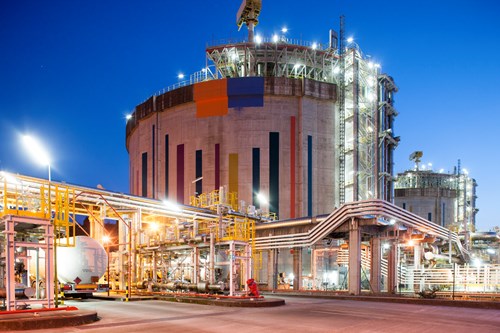
The Mugardos Energy Terminal is now ready to supply bioLNG to ships and tankers
The Mugardos Energy Terminal, owned by the Reganosa Group, offers a new bioLNG supply service that allows ships and tankers to be loaded with this decarbonized fuel. This service helps the Mugardos terminal to strengthen its participation in the decarbonization of the sector, adapting processes and consolidating its role as a key infrastructure in the energy transition.
“BioLNG is undoubtedly a real and effective alternative for moving towards climate neutrality and meeting the targets set by the FuelEU Maritime regulation, which requires the progressive reduction of greenhouse gas intensity in marine fuels. BioLNG is one of the renewable fuels recognized as meeting these objectives and enables a reduction of up to 92% in net CO₂ emissions compared to heavy fuel oil, the traditional fuel in the maritime sector,” explains Nuria Rivas, head of the Mugardos Energy Terminal.
The facility has obtained the European Union’s International Sustainability and Carbon Certification (ISCC EU), which verifies that liquefied natural gas loaded onto tankers or ships can come, in whole or in part, from renewable and sustainable sources thanks to a traceability system and sustainability certificates. This new service complies with all the environmental, social and traceability criteria established by the ISCC EU and the European Commission.
The incorporation of services such as the supply of bioLNG is one of the ways in which the terminal is working to strengthen the long-term sustainability of its activity, as it is a renewable gas obtained from organic waste and subsequently liquefied to reduce its volume and facilitate its storage and transport.
BioLNG and LNG are 100% compatible because they have virtually the same chemical composition and physical properties when liquefied. This means that they can be stored, handled and regasified in the same facilities, without the need for technical modifications. In addition, the gas obtained is equivalent and can be injected into the natural gas network without distinction.
In the current context, liquefied natural gas (LNG) has established itself as a key fuel both in terminal operations and in maritime and land transport, offering a more efficient and lower-emission alternative to conventional fuels
Related News
Related News

- Mitsubishi Heavy Industries Compressor acquires Swiss rotating equipment maintenance company AST Turbo AG
- Digital Exclusive: Evolving pressure relief valve designs protect LNG facilities
- Qatar’s Ras Laffan LNG hub hit by missile attack, ‘extensive damage’ reported
- Cook Inlet LNG advances FSRU project in Alaska (U.S.)
- JGC-Hyundai JV awarded EPC contract for major low-carbon LNG plant project in Papua New Guinea

Comments