

Japan-Qatar gas tie-up highlights global push for energy security
Qatar's long-term deal to supply Japan's power giant JERA with liquefied natural gas highlights two key themes in the red-hot market for this super-chilled fuel: the race to gain market share and the global push for energy security.
Qatar's national oil and gas company QatarEnergy on Tuesday signed a deal to supply JERA, Japan's largest power generator, with 3 MMtpy of LNG over 27 yrs, starting in 2028 (learn more).
For Qatar, the deal is a strategic win that will help ensure it keeps pace with its biggest competitor, the United States.
Qatar retains key advantages over the U.S. and other producers around the world, including lower production costs and closer proximity to Asia, the world's largest and fastest-growing LNG market.
However, the Gulf country saw its exports to Japan slip from a peak of 16.7 MMt in 2013 to roughly 3 MMt in recent years as Japanese demand softened and competition from other exporters grew.
This new deal - which will double the country’s LNG shipments to Japan - follows a string of big-ticket wins for Qatar. It has signed agreements to supply countries including China, which is the world's largest LNG importer, Malaysia and France. These deals underpin Qatar’s three huge expansion projects that are expected to increase the country’s LNG export capacity from 77 MMtpy today to 110 MMtpy later this year and 142 MMtpy by 2030.
This blistering growth should help Qatar narrow its production gap with the U.S., which seized the crown as the world’s top LNG exporter in 2023 and is expected to push capacity beyond 200 million tons a year by 2030.
Japan’s energy uncertainty. For Japan, the agreement marks a dramatic shift in its energy posture. At the start of the decade, the world's second-largest LNG importer was determined to shrink its dependence on expensive gas and other fossil fuel imports. Japan’s energy vulnerability is structural. The world’s fourth-largest economy has spent decades reliant on imported fossil fuels, with no pipeline gas options and few domestic resources.
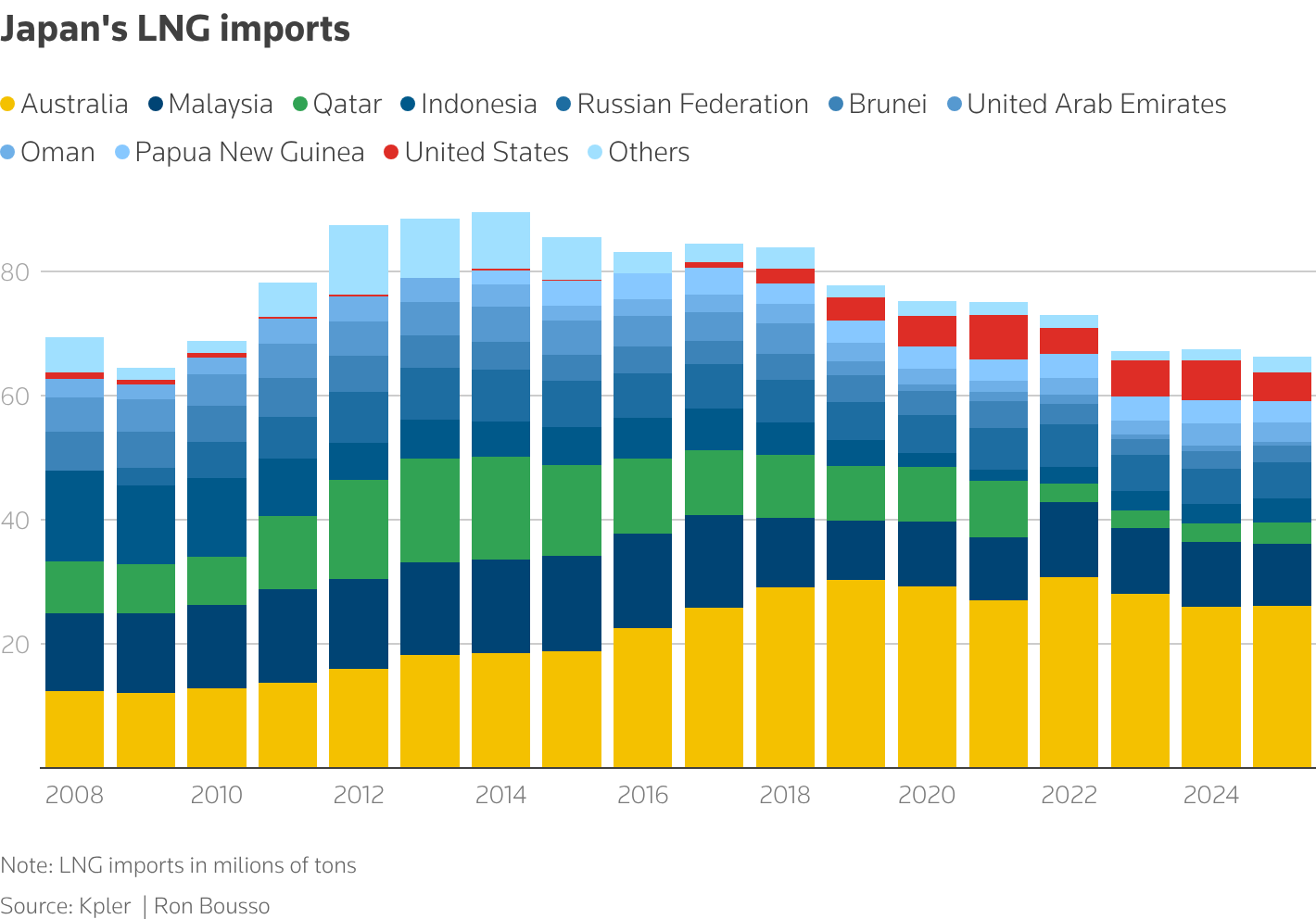
Japan began importing LNG in the 1960s, and the fuel quickly became a cornerstone of its energy system. LNG consumption reached a record high 90 MMt in 2014, after the 2011 Fukushima disaster, which forced the shutdown of most nuclear reactors. But it then steadily declined to about 66 MMt in 2025 as efficiency gains, renewables, coal and nuclear restarts chipped away at gas demand against the backdrop of a shrinking population.
So, what explains Japan’s abrupt U-turn on LNG? In a word, security.
The geopolitical turbulence of the past few years in the regions supplying the majority of Japan’s energy, most notably Russia and the Middle East, have made Tokyo reassess its access to supply.
Japan's seventh strategic energy plan, published in February last year, said that international tensions and uncertainty over the speed of the deployment of renewable technologies meant the country should secure long-term LNG contracts regardless of advances in the deployment of renewables.
The government plan said that securing stable LNG supplies was crucial for ensuring electricity supply while reducing reliance on inefficient coal-fired power plants, branding LNG-fired power plants "a practical transition measure."
The plan forecast Japan's 2040 LNG demand to range between 53 MMtpy and 74 MMtpy, depending on the speed of deployment of other energy technologies.
This new approach marks a sharp break from Japan’s strategy earlier in the decade, when the country’s utilities and traders allowed several long-term Qatari LNG contracts to lapse, much to Doha’s frustration, as Japanese buyers prioritized flexibility amid uncertain long-term gas demand.
Qatar's LNG contracts typically offer rigid terms, including long duration and requirements that cargo deliveries go to specific ports, meaning that buyers are unable to sell any fuel that exceeds their actual demand. By contrast, most U.S. LNG producers offer short-term contracts with cargo destination flexibility.
In a more uncertain world - even one in which global LNG supplies have rapidly expanded - Japan once again appears to favour security over flexibility.
The JERA–QatarEnergy deal thus speaks to the major tension in the LNG market today: net importers are wrestling with uncertain energy futures, while producers are determined to lock in buyers for decades to come.
Related News
Related News

- Freeport LNG export plant in Texas to take in more natgas after unit shut on Monday
- LNG cool-down vessel arrives at ExxonMobil's Golden Pass plant in Texas
- Freeport LNG export plant in Texas reports shutdown of liquefaction train
- TotalEnergies and Mozambique announce the full restart of the $20-B Mozambique LNG project
- JGC celebrates handed over second production train to LNG Canada

Comments