

LNG demand for ships set to at least double by 2030 globally
- LNG bunker volume to top 4 MMt in 2025, double by 2030
- TotalEnergies sees LNG, bio-LNG bunker demand at 15 MMt by 2030
- Abundant supply to lower LNG prices, improve demand
- IMO vote on net-zero plans could accelerate LNG demand
Demand for liquefied natural gas (LNG) as a marine fuel will at least double by 2030 as abundant supply and rising emissions regulations spur orders for ships that can run on it, industry executives said.
Massive LNG export projects in the U.S. and Qatar are expected to cause a supply glut by 2030, reducing prices and improving its competitiveness against conventional and more-polluting fuel oil.
LNG is pulling ahead of other fuels in decarbonizing shipping, which accounts for nearly 3% of emissions, as supply and infrastructure hurdles cloud the outlook for cleaner alternatives methanol and ammonia.
"Owners ultimately will choose the fuel that gives you the lowest cost," said Tuomas Maljanen, associate director for LNG and new energy at shipbroker Fearnleys. "LNG is great because the infrastructure is there. It's readily available ... maybe later on it's going to be, hopefully, quite cheap as well.”
Singapore, the top bunkering hub, led global LNG bunkering activity in the third quarter, followed by China and the Netherlands, according to consultancy Rystad Energy, and it plans to issue additional bunker supply licenses.
Global LNG bunkering volumes could surpass 4 MMt by end-2025 and double by 2030, said Jo Friedmann, senior vice president of supply chain research at Rystad Energy.
French energy major TotalEnergies expects global LNG and bio-LNG bunker demand to surge to 15 MMt by 2030. Some 781 dual-fueled ships can now use LNG, according to ship certifier DNV.

"Based on today's orderbook, the number of vessels will be 1,417 by 2030, but we expect this to increase as new orders are confirmed," said Kristian Hammer, product manager AFI & senior consultant at DNV.
Immediate reduction. Refueling with LNG reduces emissions from fuel oil by 19% on a "well-to-wake" basis, which refers to emissions from extraction to usage, according to Mitsui O.S.K. Lines, which owns the second largest shipping fleet. It operates 15 LNG dual-fueled vessels and has an additional 42 on order.
"Until zero or near-zero fuels are widely available, LNG remains a realistic decarbonization option for shipping in terms of availability, cost-effectiveness, and safety," the company said.
Danish shipping giant Maersk, which until last year focused only on green methanol as an alternative fuel, has ordered 20 LNG dual-fueled container ships for delivery between 2028 and 2030.
TotalEnergies expects LNG to outpace other alternative bunker fuels methanol and ammonia after 2030.
"Renewable methanol and ammonia production remain in their infancy, with limited bunkering infrastructure and a lack of economic competitiveness against conventional fuels that need to be addressed before scalable adoption is possible," it said.
Regulations. Europe's FuelEU regulation, which took effect this year, limits fuel carbon intensity for ships calling on ports there and is expected to drive adoption of LNG bunkering.
This month, an International Maritime Organization (IMO) committee will vote on a rule drafted in April that imposes emissions fees on ships that breach it and rewards vessels burning cleaner fuels from 2028. However, the U.S. rejected the deal and a group of top shipping companies are demanding changes.
"Until the IMO regulations take effect, LNG-bunkering activity remains highly sensitive to LNG bunker prices, especially for vessels operating on non-EU routes," said Rystad's Friedmann.
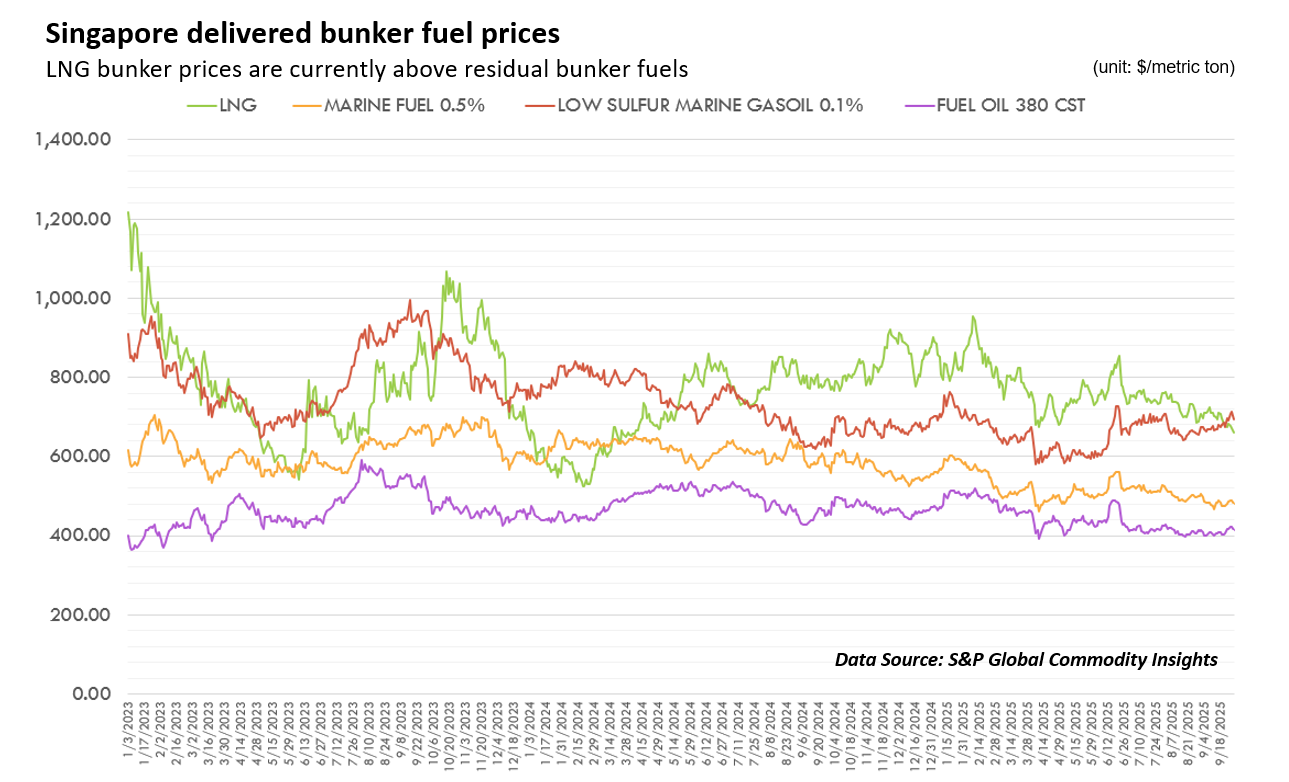
LNG bunker prices were on average $247 per metric ton higher than marine fuel in the first nine months of this year, S&P Global data showed, though excess LNG supply set to come online towards the end of the decade is widely expected to pressure prices.
Related News
Related News

- RWE strengthens partnerships with ADNOC and Masdar to enhance energy security in Germany and Europe
- TotalEnergies and Mozambique announce the full restart of the $20-B Mozambique LNG project
- Venture Global wins LNG arbitration case brought by Spain's Repsol
- KBR awarded FEED for Coastal Bend LNG project
- Norway pipeline gas export down 2.3% in 2025, seen steady this year

Comments