

Carbon-14 analysis for quantifying biogenic carbon content of hydrocarbon and fuel gases
Hydrocarbons are increasingly prevalent worldwide as a non-renewable energy source. A hydrocarbon gas is an organic compound containing carbon (C) and hydrogen (H2), found in a gaseous state. Its physical properties depend on temperature, pressure and concentration. Methane (CH4) and propane are examples of hydrocarbon gases. Hydrocarbons can be found in petroleum, natural gas, plastics, many fuels and other materials. They are also present in living organisms, such as plants.
Fuel gases are gases generated at a petroleum refinery or petrochemical plant and are combusted separately or in any combination with any type of gas. They are often made of hydrocarbon gases such as CH4 or propane. Biogenic content testing via carbon-14 analysis is a valuable tool for fuel and gas industry professionals seeking to address environmental concerns and transition toward carbon neutrality. Results can also be used to ensure regulatory compliance and for research and development (R&D) purposes, making carbon-14 analysis a versatile tool for measuring biogenic content vs. petrochemical content.
Defining hydrocarbon gases and fuel gases. Hydrocarbon gas is composed of gas molecules consisting of H2 and C atoms. A fuel gas is one of many hydrocarbon-containing gases used as a source of energy. Examples of hydrocarbon gases and fuel gases include biogas, renewable natural gas (RNG)/biomethane, syngas, co-processing gas, or geogenic CH4 soil gas.
Carbon-14 analysis measures biogenic content. Biogenic content testing measures carbon-14, an isotope present in all living organisms. Petrochemical-derived material no longer contains any carbon-14 content due to its age, as carbon-14 is lost over time via radioactive decay (FIG. 1). Results are reported as a percentage of biogenic content, which reflects the portion of the material produced from renewable feedstocks.1
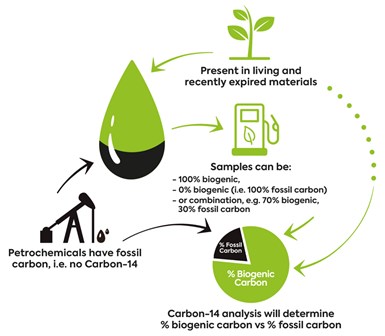
FIG. 1. Biogenic content testing measures carbon-14, an isotope found in living organisms. Source: ASTM International.
One of the main carbon-14 standards recognized in the U.S. and internationally is the ASTM International D6866 Method B using accelerator mass spectrometry (AMS). The ASTM D6866 standard testing method measures the biogenic carbon content of solids, liquids and gaseous samples using radiocarbon (14C) analysis, also known as carbon-14 analysis. These methods are applicable to any product or carbon-based components that can be combusted in the presence of an oxygen source to produce carbon dioxide (CO2) gas.
The ASTM D6866 Method B was co-developed by the author’s company’s carbon-14 testing laboratory, the ASTM committee, and the United States Department of Agriculture (USDA) and is the main standard recognized by the USDA for its BioPreferred® Voluntary Labeling Program. Under Method B, the analysis is conducted using an AMS instrument to distinguish between fossil carbon found in petrochemicals and modern hydrocarbon gas feedstocks that contain carbon-14. These feedstocks are forms of renewable biomass, a resource that can be replenished by plant growth.
14C analysis is already being used to determine the biogenic carbon content of hydrocarbon gases and fuel gases in co-processing and is the required testing for various clean fuel standards in the EU, Canada and the U.S. 14C analysis distinguishes between fossil and modern hydrocarbon gas feedstocks and product gases of pure substances and gas mixtures. Hydrocarbon gas/fuel gas samples composed of C1 to C6 single chain, branched carbon compounds, and their isomers can be measured as total carbon (bulk analysis), isolated gas targets, or grouped targets. Scientific studies from the author’s company’s research and development (R&D) department have used ASTM D6866 as a standard testing method for hydrocarbon gases. 14C and delta 13C (𝛿¹³C) results have shown reproducibility with high precision and accuracy for the analysis of total carbon (bulk analysis) and isolated gas targets of CH4 and associated CO2, propane and butane. The company has worked with a multitude of samples, including hydrocarbon gas standards, 14C standards, and samples of CH4 and associated CO2, propane, butane and carbon grouped isomers, alkenes (olefins) and alkynes to analyze the 14C and/or 𝛿¹³C content of each. ASTM D6866 has been applied to the radiocarbon analysis of CH4 and associated CO2, propane, butane, isomers, alkenes (olefins), and alkynes and can accurately report the biogenic content of hydrocarbon gases.
Results distinguish between fossil and modern hydrocarbon gas feedstocks and product gases by revealing the percentage of the sample that is biogenic- vs. petrochemical- or fossil-sourced (FIG. 2). The result of 100% biogenic content indicates that the sample is completely biomass-derived, while the result of 0% biogenic content applies to fully petrochemical materials. Any percentage in between represents a mixture.
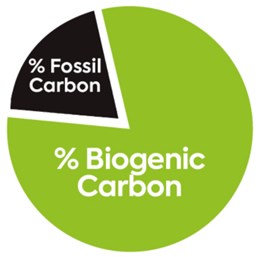
FIG. 2. Results indicate the percentage of biogenic carbon and fossil carbon in a sample. Source: SGS BETA.
Hydrocarbon gas analysis: Process and applications. 14C testing using the ASTM D6866 standard can accurately determine the biogenic percentage of hydrocarbon gases. Hydrocarbon gases can be converted to CO2, then analyzed under the ASTM D6866 Method B and accurately reported.
The author’s company developed a proprietary process to isolate gases and analyze them using the Carbon-14 methodology. Prior to analysis, operators can either decide to test the gas as a bulk or to isolate and analyze a target gas. Bulk hydrocarbon gas analysis is the 14C analysis of all the carbon-containing gases (biogenic carbon) present in a gas mixture, with the option to add δ13C analysis. A bulk analysis of the hydrocarbon gas can be completed if the sample contains < 5% oxygen. Target or isolated hydrocarbon analysis is the 14C analysis of a separated or isolated packet of gas using preparatory-scale gas chromatography. A review of a gas composition, via gas chromatography, will also be undertaken to determine the best approach to analyze each sample.
This method allows a large variety of applications for R&D purposes as it can target one of the gases present within a hydrocarbon gas to determine the biogenic percentage of the targeted gas by analyzing the 14C content. One of the unique features of the author’s company’s hydrocarbon gas capabilities is the ability to isolate and target gases within the samples regularly with concentrations as low as 3% and, after laboratory consultation, for samples lower than 3%. Isolations can consist of CH4, propane, butane and CO2. Multiple gases can also be targeted within the hydrocarbon samples and have their biogenic percentage reported. Multiple gas targets can contain the following: C2, C3, C4, C5 or C6+ groupings. There are some challenges that must be addressed when analyzing hydrocarbon gases, which include high hydrogen sulfide (H2S) and O2 concentrations, as those could pose a safety concern for laboratory personnel. Consequently, hydrocarbon gas conversion feasibility is determined on a case-to-case basis by the company’s gas team.
Landfill-derived biogas and RNG. A relevant application of biogenic content testing in these industries is for biogas derived from landfills and used to produce RNG. Similar to waste-derived fuels, biogas and RNG derived from landfills can have very favorable lifecycle assessments compared to virgin biofuels and are, therefore, eligible to receive added incentives under relevant regulatory programs.
Landfill gas (LFG) is mainly biogas formed through the fermentation of organic waste and is usually composed of CO2, CH4 and other volatile organic compounds (VOCs). The production of LFG continues until the majority of the organic waste has been degraded. The maturity of the landfill influences the concentrations of CH4 and CO2 in the LFG. More recent landfills will have different ratios of CO2 and CH4, while old landfills (> 10 yrs) would have a 50/50 ratio. In those applications, gas chromatography (GC) can reveal the maturity of the landfill and provide more accurate data on the LFG composition.
While organic waste fermentation will produce a biogenic LFG, LFG is not the only potential source of CH4/gas in the landfill parameter. Other sources include the decay of petroleum waste through fermentation, natural gas from buried supply lines and natural gas from underlying petroliferous reservoirs. Therefore, biogenic content testing allows producers of these fuels to demonstrate the amount of renewable content in the biogas extracted from the landfill and the final RNG product.2
Regulatory programs focused on lowering the carbon intensity of fuels that require direct biogenic testing for biogas and RNG derived from landfills include the U.S. Renewable Fuel Standard (RFS)3 and the EU’s Renewable Energy Directive (RED).4 Various regulatory bodies around the world (e.g., the U.S., Australia, the EU) are also increasingly looking to regulate LFGs (such as CH4 and propane).
Flue gas emissions analysis. Another relevant industry application of biogenic content testing is the direct measurement of flue gas emissions. Biogenic testing for emissions reporting and cap and trade programs regulating large industrial emitters are increasingly recommended by regulators for monitoring purposes. By allowing regulated entities to directly test their flue gas for biogenic content, these measurements enable producers to obtain and provide regulators with critical information on their emissions reductions. It can also help them claim carbon credits and tax credits. One of the latest examples of this are the U.S. EPA’s Biogas Regulatory Reform Rule’s (BRRR’s) RFS rules which, starting from January 1, 2025, will allow operators to claim renewable identification numbers (RINs) if they can justify a biogenic portion for their hydrocarbon gas using direct carbon-14 testing.
Regulatory programs focused on emissions reductions that require direct biogenic testing of flue gas emissions from industrial facilities include the U.S. EPA’s Greenhouse Gas Reporting Program (GHGRP),5 California’s (U.S.) Cap and Trade Program, Canada’s Greenhouse Gas Reporting Program (GHGRP)6 and the EU’s Emissions Trading System (EU ETS).8 Direct biogenic testing of flue gas emissions has been well-established in these programs; for example, quarterly testing and reporting have been successfully implemented by the U.S. GHGRP for > 12 yrs.
Biogenic carbon measurement ensures carbon neutrality. Biogenic content testing via carbon-14 analysis is a valuable tool for responding to environmental concerns and transitioning toward carbon neutrality. Additionally, results also support compliance with current regulations. Major refineries, chemical plants, energy labs, third-party labs, environmental firms, geologic carbon removal technology developers and renewable carbon technology developers can benefit from biogenic content testing of their hydrocarbon mixed gases coming from coprocessing plants, refineries, RNG producers and more. Analysis applies to samples including bulk composition gases, isolated gases of CH4, CO2 (in a mixture or “raw biogas”), propane and butane, as well as hydrocarbon gases composed of biogas, LFG, biomethane, RNG, coprocessing gaseous fuels, renewable gas feedstocks, syngas, geogenic CH4, soil gases, waste-to-energy gases, enteric gases, renewable propane, low-carbon intensity fuels, bioreactor gases and intermediate gases.
Biogenic carbon in fuels and gases derived from biomass are carbon-neutral because burned biomass releases CO2 captured during photosynthesis. Because it releases CO2 that already existed in the atmosphere, it does not emit new or additional CO2 and does not contribute to climate change. Conversely, fossil fuel feedstocks are non-renewable resources and release CO2 that has not been an active part of the carbon cycle for millions of years when burned. Because fossil fuels add new CO2 to the atmosphere, they are not carbon-neutral and thus contribute to climate change.
Overview of regulations for hydrocarbon gases and fuel gas. Direct carbon-14 testing has been included in the main North American and EU programs to monitor emissions reductions and the production of renewable fuels as well as regulate hydrocarbon and fuel gases. In the U.S., the main regulation for biogas and RNG is the U.S. RFS, which requires ASTM D6866 for biogas and RNG in its 2023 set rule. In Canada, gases and fuel gases are regulated under Canada Clean’s Fuel Regulation (CFR) and the Canada GHGRP. Canada’s GHGRP requires testing using ASTM D6866 if combustible fuels or fuel mixtures contain a biomass fraction that is unknown or cannot be documented. In the EU, the EU RED directive requires regular 14C analysis to verify that calculation-based approaches are also required for RNG produced as a byproduct of co-processing.
Various governments, such as Australia8, the U.S.9, New Zealand10 and Canada6 are looking to increase regulations for hydrocarbon gases by publishing requests for information to gather feedback from interested parties.
The author’s company’s policy team actively monitors and advocates for international regulations and policies requiring carbon-14 testing to stay updated on new developments.
Takeaways. ASTM D6866 biogenic carbon content testing measures carbon-14 in hydrocarbon and fuel gas samples to identify how much biogenic carbon vs. fossil carbon is present in the sample. This data is valuable for monitoring carbon neutrality and also ensures compliance with regulations that require analysis such as the U.S. RFS standard. Since carbon-14 is only present in biomass feedstocks, the testing is a reliable indicator of whether a fuel or gas sample is primarily sourced from renewable materials as opposed to non-renewable resources.
LITERATURE CITED
1 Kerfoot. H. B., B. Hagedornb and M. Verwiel, “Evaluation of the age of landfill gas methane in landfill gas-natural gas mixtures using co-occurring constituents,” Environmental Science: Processes & Impacts, Iss. 6, 2013.
2 National Archives Code of Federal Regulations, “40 CFR Part 98 Subpart C—General stationary fuel combustion sources,” 2016.
3 Government of Canada, Environment and Climate Change Canada, “Canada’s greenhouse gas quantification requirements,” 2020.
4 European Commission, “Biomass issues in the EU ETS,” 2022.
5 ASTM International (D6866-21), “Standard test methods for determining the biobased content of solid, liquid, and gaseous samples using radiocarbon analysis,” 2021.
6 Government of Canada, Environment and Climate Change Canada, “Quantification method for co-processing in refineries,” 2022.
7 U.S. Environmental Protection Agency (EPA), National Archives Code of Federal Regulations, “40 CFR Parts 80 and 1090– Renewable Fuel Standard (RFS) Program: Standards for 2023–2025 and other changes,” 2023.
8 U.S. Department of Energy, “DOE RFI on renewable propane and other gaseous intermediates," 2024, online: https://www.energy.gov/eere/bioenergy/us-department-energy-releases-request-information-renewable-propane-and-other
9 U.S. Environmental Protection Agency (EPA), “Final Renewable Fuels Standards Rule for 2023, 2024, and 2025,” 2023.
10 “Australia reform options for ACCU scheme landfill gas methods,” open consultation, 2024.
ABOUT THE AUTHOR
Jessica Ballasi is a Policy Research Associate and Account Manager at Beta Analytic. Her work aims at researching EU regulations to keep clients up to date with regulatory developments and promotes bio-based testing at the EU level.


Comments