

After 30 years, I am still betting on solid-rotor motors for critical high-speed applications
Solid-rotor technology can be considered to have quietly faded into obscurity—the reality is quite the opposite. Its best days may still lie ahead, especially for demanding high-speed industrial processes.
The 'underdog' motor. When I first jumped into the world of power electronics and motor technology > 30 yr ago, the focus was on pushing conventional two-pole induction motors to higher speeds for industrial processes. Solid-rotor motors were already known, but they were seen as a quirky niche option—potentially suited for some extreme cases, but hardly the future.
Fast forward to today, and the picture has changed dramatically. Solid-rotor motors are not only still relevant, they are also thriving in some of the fastest-growing industrial sectors. After decades of watching motors succeed, fail and evolve, I can say with confidence that, for the most demanding high-speed applications, solid-rotor technology is still the best bet.
What makes a solid-rotor motor special? A solid-rotor motor uses a rotor machined from a single, solid piece of metal. In its simplest form, it is a machined piece of magnetically conductive steel. In a more sophisticated form, it is comprised of electrically conductive end rings—a cage can even be added to improve performance.
This differs from conventional induction motors, which rely on laminated iron cores with copper or an aluminum cage, and from permanent magnet (PM) motors, which use rare-earth magnets fixed to the rotor. In a pure solid-steel rotor, the magnetic core also acts as the electrically conductive part of the rotor. With the cage structure, the performance can be compared to a laminated rotor, except for the rigid rotor structure.
This simple but powerful design offers exceptional resilience at high speeds, making solid-rotor motors ideal for environments where conventional laminated rotors deform, magnets weaken and chemical stress on the materials is harsh.
High-speed applications demand more than standard motors. Most high-speed industrial processes today still rely on conventional two-pole induction motors, which operate comfortably at around 3,000 rpm–3,600 rpm. With variable frequency drives (VFDs), they can push to about 5,000 rpm; however, that is still too slow for many modern processes. To increase speed, users typically add a high-speed gearbox between the motor and the equipment (e.g., compressor, blower).
This is where solid rotors change the game. By eliminating the fragile laminations, solid-rotor motors are naturally suited to ultra-high speeds: 20,000 rpm–30,000 rpm, or even higher. They also handle:
- High process temperatures
- Contaminated or corrosive gases
- Tight space and vibration limits.
In industries like chemical processing, air separation and liquefied natural gas (LNG) production, where downtime can cost millions, solid rotors deliver unmatched reliability.
The direct-drive advantage. As more industries embrace direct drive systems—where the motor connects directly to the load—solid rotors gain even more relevance. Direct drive eliminates gearboxes, improving system efficiency and cutting maintenance costs.
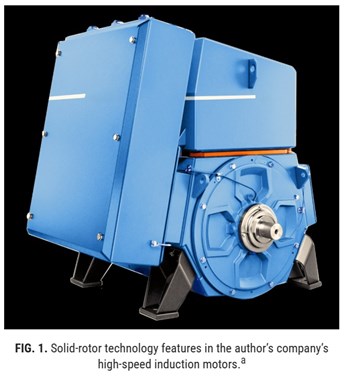
However, direct drive only works if the motor can operate at process speeds, often upwards of 20,000 rpm. That is a realm where conventional induction motors fail and PM motors struggle. Solid-rotor motors shine here, thanks to their mechanical simplicity, high stiffness and superior heat dissipation (FIG. 1).
Results include:
- Fewer bearings
- Lower vibration and longer bearing life
- Less maintenance and lower lifetime costs.
That is not just clever engineering—it is a clear financial advantage for operators.
Efficiency vs. reliability: The real-world trade-off. PM motors can deliver slightly higher efficiency in some conditions, particularly at lower speeds in clean environments. In real-world industrial processes, however, reliability trumps efficiency every time.
A tiny efficiency gain means nothing if it comes at the cost of unplanned shutdowns. Solid-rotor motors sacrifice a bit of peak efficiency to deliver rock-solid durability, especially in high-speed, high-temperature and contaminated environments.
Ready for the green future. As industries push toward decarbonization, advanced manufacturing and cleaner energy, the case for solid-rotor motors only grows stronger. Some of the most promising growth markets where solid rotors have a natural edge include:
- Industrial gas and hydrogen (H2) processing: The global push toward a H2 economy requires ultra-reliable cryogenic compressors and turboexpanders—machinery operating in extreme cold at extremely high speeds. Solid rotors thrive in cryogenic environments, with no magnets to demagnetize and no laminations to warp. They are ideal for H2 liquefaction, LNG processing and air separation units.
- Semiconductor manufacturing and high-vacuum systems: As global semiconductor demand surges, high-speed turbo-molecular pumps are critical for vacuum processing. Solid-rotor motors provide extreme speed with low vibration, ideal for ultra-clean manufacturing where contamination is not an option.
- High-speed compressors for process industries: From wastewater treatment to petrochemical plants, high-speed blowers and compressors are replacing older, inefficient systems. Solid-rotor motors handle stress and heat better than both laminated and PM options, enabling dependable direct-drive solutions that eliminate gearboxes.
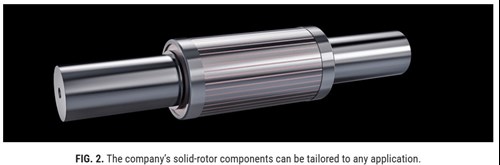
The differentiator: Innovation through collaboration. The author’s company is not just building motors: it is working directly with customers to co-engineer solutions that fit their exact needs (FIG. 2). One of the standout advances is the use of ceramic bearings for solid-rotor motors. These bearings handle higher temperatures and speeds than conventional options, further improving reliability in extreme environments. When there is a need for megawatt (MW)-class power and high speed, active magnetic bearings are available.
Whether it is a custom bearing system, an optimized rotor design or an integrated power electronics package, the author’s company co-creates the solution. In a world where off-the-shelf motors too often fail, this collaborative approach ensures solid-rotor motors deliver the reliability, performance and lifecycle cost control that high-speed industries demand.
Built to last. Built for the future. It is a bit ironic: the solid-rotor technology I was introduced to as a young engineer, once dismissed as outdated, is now one of the most future-proof solutions for the toughest industrial challenges of our time.
After 30 years in this business, if there is one truth I know, it is this: there is no such thing as a one-size-fits-all motor. For some processes, PM motors are great. For others, conventional induction motors still get the job done.
But for high-speed, high-reliability applications where failure simply is not an option, my bet is still on solid-rotor technology. Not because I am nostalgic, but because I know from experience what works when it matters most.
NOTE
a BEMAC
ABOUT THE AUTHOR
Panu Kurronen is CTO based in The Switch’s hub in Lappeenranta, Finland. Prior to joining the company at its very start, Dr. Kurronen worked as a Technical Manager at Rotatek Finland Oy, one of the three companies that initially merged to form The Switch in 2006. He graduated as a Doctor of Science (El.eng.) from Lappeenranta University of Technology in 2003. Over the years, he has worked as a researcher, laboratory manager and associate professor at Lappeenranta University of Technology. From 1995 to 2000, Dr. Kurronen worked as a Project Manager at Kone Elevators. His focus has mostly been on the application of permanent magnet technology, but he has always maintained a soft spot for the humble solid rotor.


Comments