

Marine fuel sales in Singapore bunker hub scale fresh highs in 2025
Marine fuel sales scaled new highs in the world's largest bunker hub of Singapore during 2025, the Maritime and Port Authority of Singapore (MPA) said, supported by resilient global trade and fuel offtake.
Singapore's bunker sales totaled 56.77 million metric tons in 2025, according to the MPA, surpassing a previous record of 54.92 million tons in 2024.
Container throughput climbed to 44.66 million twenty-foot equivalent units (TEUs) in 2025, also hitting a new high, while annual vessel arrival tonnage grew to a record of 3.22 billion gross tons (GT).
The uptick in bunker sales was also supported by robust demand for high-sulphur marine fuel, which saw volumes rising for a fifth consecutive year, based on MPA data.
Sales of high-sulfr marine fuel (MFO) totaled 21.73 million tons in 2025, up 7.8% from the previous year, while low-sulfur fuel oil (LSFO) totaled 28.83 million tons, down 2.5%, showed calculations based on MPA data.
Meanwhile, some shipowners lifted more alternative marine fuels to support their emission reduction plans. The use of alternative marine fuels rose to 1.95 million tons in 2025, compared with 1.35 million tons in 2024, MPA said.
Both marine biofuel blends and liquefied natural gas (LNG) sales were up for a third consecutive year, based on data from the MPA published for these grades starting from 2022.
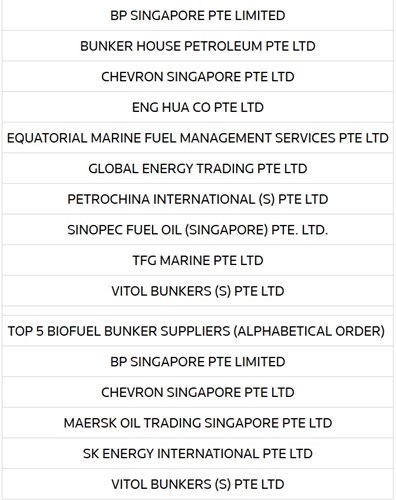
Sales of biofuel blends grew to 1.36 million tons in 2025, up more than 54% from 2024, while sales of liquefied natural gas climbed to 571,400 tons, up 24% from a year ago.
MPA will open applications for new LNG bunker supply licenses from January 14 to better fulfil growing demand, it added.
Related News
Related News

- Mitsubishi Heavy Industries Compressor acquires Swiss rotating equipment maintenance company AST Turbo AG
- RWE strengthens partnerships with ADNOC and Masdar to enhance energy security in Germany and Europe
- TotalEnergies and Mozambique announce the full restart of the $20-B Mozambique LNG project
- Cook Inlet LNG advances FSRU project in Alaska (U.S.)
- Qatar’s Ras Laffan LNG hub hit by missile attack, ‘extensive damage’ reported

Comments